Wednesday, October 2, 2019


Thursday, May 2, 2019
Baba Farid Ganjshakar (1173-1265)
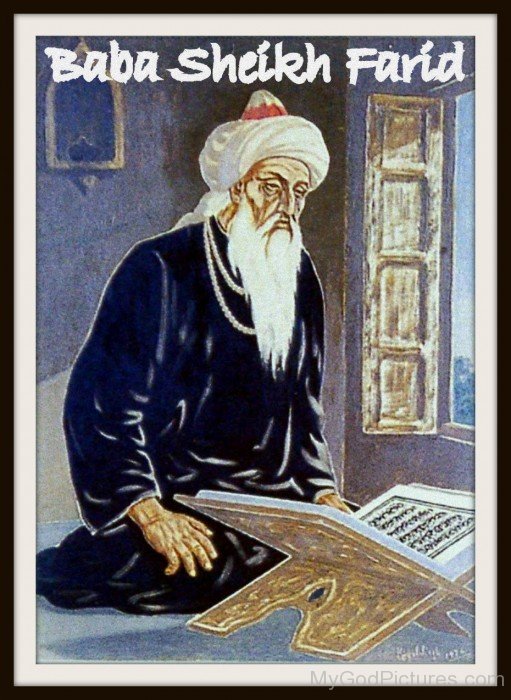 In His, Sai Baba the Master, 'A Sketch of His Life -1', Acharya Ekkirala Bharadwaja refers to Baba Farid Ganj Sakkar.
Fariduddin Masud was a great Sufi master who was born some time in the 12th Century at a village called Kothewal, 10 km from Multan in the Punjab region of what is now Pakistan,. He was a Sunni Muslim and was one of the founding fathers of the Chishti Sufi order. Baba Farid received his early education at Multan, which had become a centre for Muslim education; it was there that he met his teacher Qutbuddin Bakhtiar Kaki, a noted Sufi saint, who was passing through Multan on his way from Baghdad to Delhi] Upon completing his education, Farīd left for Sistan and Kandahar and went to Makkah for the Hajj pilgrimage with his parents at the age of 16.
Once his education was over, he moved to Delhi, where he learned the Islamic doctrine from his master, Qutbuddin Bakhtiar Kaki. He later moved to Hansi, Haryana. When Quṭbuddīn Bakhtiyār Kākī died in 1235, Farīd left Hansi and became his spiritual successor, and he settled in Ajodhan (the present Pakpattan, Pakistan) instead of Delhi. On his way to Ajodhan, while passing through Faridkot, he met the 20-year-old Nizamuddin Auliya, who went on to become his disciple, and later his successor Sufi khalīfah. In Faridkot, while working as a labourer in building a fort of the Raja of Faridkot. The Raja received his blessings once the Raja realised who he was as he was able to carry bricks over head without the bricks touching him. The Raja immediately saw the divinity in him and requested to become his follower. The Raja and his descendants dedicate many shrines in his memory. His nephew and disciple and successor Alauddin Sabir Kaliyari was amongst the greatest Sufi saints and from him Sabiriya branch under Chisty order started. (Source: Wikipedia)
There are several stories as to how Baba Farid acquired the title 'Ganjshakkar'. One of them is as follows:
According to Siar-ul-Arifin, when Baba Fariduddin was under the spiritual training of his Pir-o-Murshid, Hazrat Khwaja Qutbuddin Bakhtiar Kaki at Delhi, he was asked to fast for 7 days at a stretch. One day, during this period, when he was proceeding from his hujra' (cell) in Ghuzni Gate towards Hazrat Khwaja Qutbuddin's Khanqah (monastery), his foot accidentally slipped in a marshy pothole and he fell down in the mud, some of which entered into his mouth which, by the grace of God, became sugar. When he related this incident to his Pir, Hazrat Khwaja Qutbuddin, the saint said: "If mud has become sugar in your mouth, then God most gracious will make you a very sweet personality and you will become sweet-tongued for the benefit of the people." After this incident, people began to call him 'Ganjshakar'. ("Ganj" in Persian means 'treasure' and 'Shakar" means 'sugar')
(Source:sufiwiki.com)
Another story goes: "A trader was taking a caravan of camels laden with bags of sugar from Multan to Delhi. When he was passing through Ajodhan (now Pakpattan), Hazrat Baba Fariduddin casually asked him as to what was he carrying on his camels? The trader foolishly replied, "it is salt".
Hazrat Baba Farid affirmed: "Yes, it may be salt". When the trader reached Delhi, he was perturbed to find that all his bags of sugar had turned into salt. He immediately returned to Ajodhan and apologised before Baba Farid for his impertinent behaviour. Baba Farid said: "If it was sugar then it shall be sugar." The trader returned to Delhi and was pleased to find that the salt had turned into sugar by the grace of God. This was the third confirmation of his title as Ganjshakar.
The famous poet Bairam Khan, Khan-e-Khanaan, has mentioned this miracle of the saint in a Persian couplet:
| “ | Kaan-e-Namak, Juhaan-e-shakar, shickh-e-bahr-o-bur,
Aan kaz shakar namak kunad-o-azz namak shakar.
| ” |
| “ | The great saint (Hazrat Baba Farid) who rules over both the seas and the land,
is a mine of salt and a world of sugar, because he turns sugar into salt and salt into sugar.
| ” |
(Source:sufiwiki.com)
Baba Farid's poetry in Punjabi is distinctive and finds parallels in the works of later poets of the 17th and 18th century. He is generally recognized as the first major poet of the Punjabi language and is considered one of the great saints of the Punjab. He is one of the fifteen Sikh bhagats and selections from his work are included in the Sri Guru Granth Sahib. His poetry in the Sri Guru Granth Sahib includes four Shabads (hymns) and 112 Shlokas. He is respected equally among Muslims, Hindus and Sikhs.
Thursday, March 14, 2019
'...Did he smile his work to see?'
Recalled this beautiful childhood poem and marvelled yet again at how Blake looked at the Tiger and the Maker. Such powerful imagery, and recurring symbolism of the furnace and anvil in sacred poetry.

Tuesday, February 27, 2018


Monday, January 22, 2018

Wednesday, November 22, 2017
'Science and Spirituality' and Permaculture; Fritjof Capra
On one of Acharya Ekkirala Bharadwaja Master's visits to our house in Delhi, he introduced Fritjof Capra's The Turning Point (1982) to my father, Dr Guda Venkatappa Rao. It appealed to his and other people of 'modern', educated mindset. It appeared too vast and deep a subject for us to grapple with but we grew up knowing its value. In Mastergaru's Delhi speech, He addressed scientists and Professors from the prestigious Indian Institute of Delhi and floored them by speaking about spirituality in their scientific idiom.
One of Acharya Ekkirala Bharadwaja's most significant contributions to the post-modern era was his advanced and well-researched scientific exposition of the basis of spirituality. In his iconic book, Edi Nizam (What is the Truth?), he delves into the question, that has had philosophers over centuries pondering and debating, with hardly any reference to the word 'God' or any religion. In His Vignana Veechikalu (Essays on Science and Spirituality, 1981), He elaborates using the works of several prominent scientists in his argument. One of them is Professor Fritjof Capra. The 78-year-old physicist who is now Director of Centre for Ecoliteracy in Berkeley, California, is best known for his first book, The Tao of Physics: An Exploration of the Parallels between Modern Physics and Eastern Mysticism (1975), which has sold over a million copies worldwide.
Here is a link to his recent interview which appeared in The Hindu, Sunday, 19th November, 2017.
What would have Mastergaru done today, is a question to ponder. It is said that great minds think alike and we can see this in what Professor Fritjof Capra says in the above interview:

" ...What we have been writing about for decades is now happening: climate change, for instance. I wrote about global warming in 1989. For decades, no one listened and made fun of us, but we are now in the midst of a climate catastrophe. Now I think the situation is changing because businesses which don’t have ideologies — they want to invest money, to flourish — are turning away from fossil fuels. If they had listened to us then, we would have had a different world today. It’s almost too late, hopefully not."
"...We have to build alternative communities and do things that don’t depend on global capitalism. In the energy field, we can have independent solar power: in California, for instance, I don’t pay for electricity because I have solar panels on the roof and California is such that I don’t need batteries to store electricity. The energy I produce is sold to the grid."
How similar he sounds to Bill Mollison, the founder of Permaculture and author of 'Permaculture: A Design Manual'.

With all his courses on Permaculture especially to the Nagole devotees, where he is fostering a community spirit, we can see how, Babugaru, Ekkirala Dwarakanath Jnaneswar, is doing immense service to the Earth and the future of humankind.
#Fritjof Capra #Acharya Ekkirala Bharadwaja # Science and Spirituality # Spirituality and Permaculture # Spirituality and community life #alternate communities
Saturday, October 28, 2017
On Seeing Them words fail


fail.
At once close
and at once far.
Unfathomable
mystery
No vision
No wisdom
of the mighty seers
who See.
Will I be saved?
Alas, how selfish is this I
who wants alone to be saved
and yet cries of loneliness
I have seen Him in His divine form,
Him with the matted locks,
Him with the jewelled crown,
Him with the gleaming teeth,
Him with the smiling face,
Him who illumines the fourteen worlds with
the light of His eyes.
I have Him and the thirst of my eyes is
quenched.
I have seen the great Lord whom the men
among men serve but as wives.
I have seen the Supreme Guru Chenna Mallikarjuna
sporting with the Primeval Sakti,
And saved am I.
Him with the matted locks,
Him with the jewelled crown,
Him with the gleaming teeth,
Him with the smiling face,
Him who illumines the fourteen worlds with
the light of His eyes.
I have Him and the thirst of my eyes is
quenched.
I have seen the great Lord whom the men
among men serve but as wives.
I have seen the Supreme Guru Chenna Mallikarjuna
sporting with the Primeval Sakti,
And saved am I.
Wednesday, April 19, 2017
Stree Shakti - Nagole women tilling the earth

These photos are from about a year ago. We were charged with tilling hardened garden soil to make three double dig beds. Rubble from the next door construction filled the eastern part of the site while the westerned side got more shade from the southern building and roadside trees. Selecting a suitable area in between (the garden was not a permaculture design garden or with any design for that matter!), we experimented with mixing the base red soil with fresh cowdung to make a sort of thick bed liner. It was downright hard work, what with having to move some large stones as well.
Then the beds were filled in with coco-peat and mixed with more cowdung and watered. After a couple of days of this, we sowed methi for a quick crop. The result was a lustrous bed of green in five days only. Unfortunately, the site was suddenly taken over for development and I could not get the later photos! Perils of urban permaculture :-/.
Tuesday, April 11, 2017
 a
aThursday, April 6, 2017
Sree Raama Navami April 5th 2017
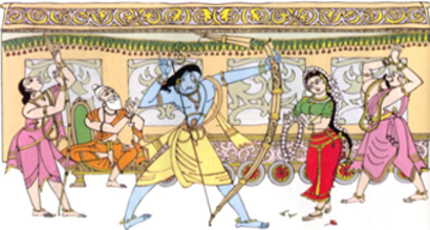
Artist Bapu's vision of Sita Swayamvara.
Very early in the morning, I begin to hear strains of Puja stotras and Rama bhajans from temples and households. A peek outside gives me glimpses of women cleaning the front of their gates and doors and decorating with rangavalli.
It is Sree Raama Navami, the day on which he was born and also the day of Seeta & Rama's
marriage. The classic song 'Seeta Kalyaana Vaibhogame'
( the splendour of Seeta's marriage) is heard on virtually every marriage pandal in South India and elsewhere. On the day of their marriage, every bride and groom is the embodiment of Seeta and Rama/ Goddess Lakshmi (goddess of material and spiritual wealth) and Lord Vishu (the Lord who is the personification of the Universe and also its preserver/protector). And the witnesses of such a marriage are akin to the great seers and Vedic rishis of yore, who attended the marriage of the Goddess of the Earth to the God of the Universe in the human form.
Tuning our minds to that all-pervading Divine presence, visualizing that splendour, that glory, having prepared in anticipation for the last eight days with fasting and worship, today we take ritual oil baths and make preparations for welcome, the ceremony and the wedding feast of the very embodiment of sacredness.
 |
| Nagole Satsanga Group's 'Common Kitchen' making Nivedana at |
'Sree Raama Namam Maruvam Maruvam...." Bhadrachala Ramadasa Keertana
God is spirit, and those who worship him must worship in spirit and truth. —John 4:24 NRSV
The Lord is a stronghold for the oppressed, a stronghold in times of trouble. And those who know your name put their trust in you, for you, O Lord, have not forsaken those who seek you. —Psalm 9:9–10 NRSV
Thursday, March 30, 2017


Wednesday, September 7, 2016
Vinayaka Chavithi Subhaakaanshalu + Babugaru's Facebook post on meaning of 'Ganapati'

Re-sharing my most favorite part of Permaculture design manual. This is so close to the concept of 'Ganapathi' (the lord of the concept of diversity - Gana means countable, diverse) and 'Gajanana' (Ga+Ja+aanana, the one whose facade is all that 'moves' and 'changes' and 'events' and one who is behind it all) that it is an appropriate share the day after Vinayaka Chaviti. So far, this is the closest any system (that deals with the physical and the mundane aspects of life) has gotten to the highest spiritual ideal as presented by the Vedas. Democracy and marxism pale before the level of ideal presented by this book regarding humans and the world at large. If you have not yet, do purchase permaculture design manual. It costs about 12000 rs., and is well worth every rupee. Yes it is costly, by the way. But I would sell a gold ring to buy that book without blinking an eye. Literally worth its weight in gold in my opinion. By my experience, the highest rating for books in my opinion goes to books by Mahatmas, the likes of Vivekananda, Ramana Bhagavan, Potana bhagavatam, Yoga vasishtyam, patanjali Yoga sutras, etc. Second place goes to books by fritjoff capra, "my experiments with truth" by Mahatma Gandhi, and Permaculture design manual. And most other books come next. Fashion apparel last but one place after almost all other things, and movies are last in terms of where to spend money.


Subscribe to:
Posts (Atom)